AI is becoming a workforce. Manage it like one.Turn visual signals into assigned work.
Bespin builds the full stack beneath your agents, runs it after launch, and holds every agent to the result it was hired to deliver.Bespin connects camera feeds to AI decisions and business workflows, so teams can act while the signal still matters.
Bring one workflow that is slow, expensive, or stuck. Our engineers will walk it through the seven layers with your team and scope the build that closes the gap.
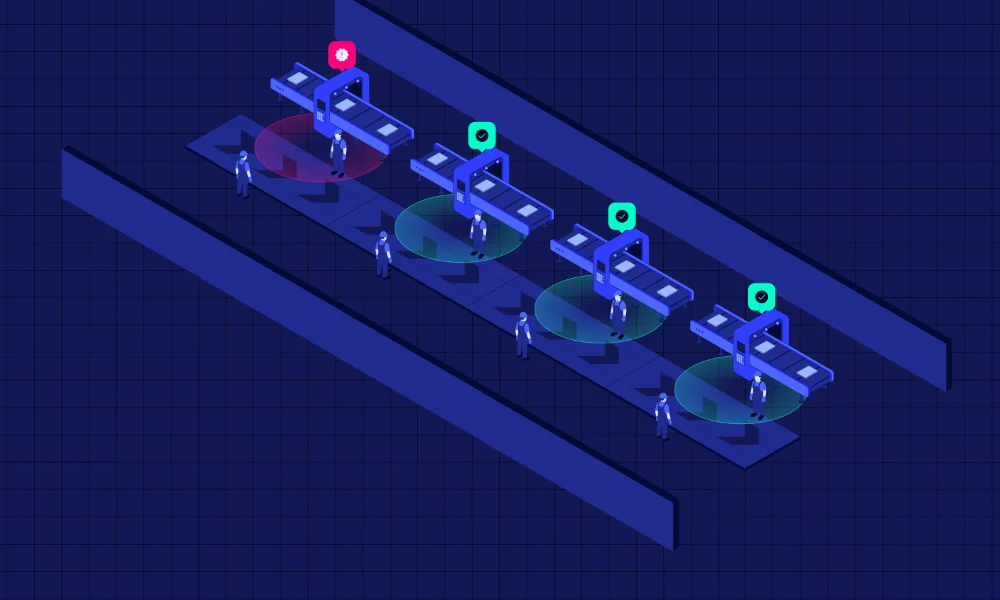
A detection only matters when it reaches the right person with enough context to act. Orbit Vision AI connects the cameras you already have to Bespin’s own detection models, agent triage, and the systems where work gets assigned.
Agent triageProximity risk, station 1Owner notified with evidence attached
Orbit modelsEdge inferenceAgent triageWork orders
The detection is not the hard part.
Any vendor can sell a model that spots a defect. Orbit Vision AI is one surface on Bespin’s full stack: the same infrastructure, model routing, and agent workforce we run for the rest of the business, so a detection arrives as a decision, not a frame.
Vision detectionThe part every vendor already sells
Infrastructure and model routingWhere it runs, and which model answers
Agent workforceApplies site policy, shift history, and severity
Assigned workReaches an owner, with the evidence attached
What one detection sets off.
The same dock event from the diagram above, in four frames: what the camera sees, what gets logged, what the plant does on its own, and what a supervisor can still ask.
What the model reads
“A forklift and a pedestrian are both inside the marked walkway, about 1.8 meters apart.”
Forklift 0.97Person 0.99Zone 2
The model writes the scene out in words before anything acts on it. Every step after this reads that sentence, which is why a supervisor can argue with the decision instead of guessing at a score.
Work order raised
Safety response, Dock 4
WO 4471P1
TriggerProximity breach in the Dock 4 walkway
EvidenceClip and annotated frame attached
SeveritySet from site policy, the shift, and prior events at this bay
DSAssigned to the dock supervisor, waiting on acknowledgement
Written into the maintenance system you already run, not into a second inbox.
Control action dispatched
Beacon and horn, Dock 4
BEACON D4ON
HORN D4ON
CONVEYOR D4RUN
BAY DOOR D4OPEN
Dispatched to the control point configured for this station, and logged like every other action an agent takes.
Ask the SOP agent
Dock supervisorDock 4 beacon tripped. What do I check before I clear it?
SOP agent
Three checks before you reset it:
Confirm the walkway is clear and the forklift is out of the lane.
Reset the beacon at the station panel, not at the breaker.
Log the sign-off, then the line can restart.
Read from your dock safety procedure
Four systems, one event, nothing re-typed between them. The frames here are drawings of the mechanism, not customer footage.
What Orbit watches for.
Four detection patterns cover most of what plants ask us for, and each one runs the same three steps. The classes inside a pattern are trained on your product, your lines, and your rules, so this is the shape of the work rather than a parts catalogue.
Surface and finish defects
Continuous lines, where one grader cannot watch every meter of every shift.
The camera reads
Marks, tears, inclusions, and shade drift, scored against the defect classes your graders already use.
The agent decides
Whether this is one noisy frame or a run forming, by reading the last hour on the same line and the grade history for that product.
The work lands
A graded event on the line dashboard, and a work order once the run crosses the threshold operations set.
Where the count is a clipboard, a spreadsheet, and an argument at the end of the shift.
The camera reads
Pieces, units, pallets, and loads at the moment they pass a camera, per line and per shift.
The agent decides
Where a count diverges from the system of record, by how much, and whether the gap sits inside tolerance.
The work lands
A reconciled count, and an exception raised to an owner when the gap is outside it.
Each frame is a drawing of how that pattern runs, built from the same boxes, labels, and verdicts the operator sees. None of it is customer footage.
Most plants have bought vision before.
Often more than once, and none of it reached the maintenance system. Orbit Vision AI is built to be the last vision system a plant buys.
What most plants have
One defect on line 1Vendor A
One defect on line 3Vendor B
One loading dockVendor C
Maintenance systemNothing arrives. The inspection is still manual.
Orbit Vision AI
Surface defectsEvery line
Process-condition detectionEvery line
Forklift and pedestrian proximityEvery dock
Piece and unit countingEvery site
Maintenance systemA work order, assigned, with the clip attached.
One platform from camera to closed work order.
Orbit Vision AI runs models we train on your lines, defect classes, and safety rules, and we own every step between the camera and the fix.
Cameras already on siteYour hardware
Orbit detection modelsBespin
Edge inference and routingBespin
Multi-agent triageBespin
Work order in your maintenance systemYour system
One team and one platform. No handoffs between vendors. The triage step runs on the same agent workforce behind our agentic AI practice, not a scripted notification rule.
Orbit detectionUnsafe proximity at Dock 4
Agent triageSite policy and history applied
Assigned workSupervisor acknowledges, zone clears
Orbit sees the risk, an agent adds site context, and the right person gets the work with the evidence attached.
Start with one line. Scale by site.
Operations and safety agree the detection accuracy test before anything scales. Each new site is commissioned on its own, not in one cutover.
One lineAccuracy test agreed with operations and safety
One siteEvery line on the same platform
Every siteEach one commissioned on its own
Runs on Infrastructure at the edge · Model operations and routing · DataOps · Agent build and operations
Where the work lands.
A detection that stops at a dashboard is a notification. Orbit Vision AI writes into the systems that already run the plant, and it writes the evidence with it.
Maintenance and work orders
A work order in the system that already runs the process, with the clip, the frame, and the zone attached, so nobody re-types the event.
Write
Plant control points
A beacon, a horn, or a stop, dispatched to the control point configured for that station and logged like every other action.
Act
Operator chat and SOP lookup
A supervisor asks what to check and gets the answer out of your own standard operating procedures, with the step and the sign off it needs.
Ask
Dashboards operators open
Per line, per shift, per site. Built to be opened during a shift rather than reviewed after one.
Watch
Alerting and escalation
The channel your team is already in, on the escalation path operations set, not a separate inbox nobody checks.
Notify
Every action is logged with the frame that caused it, so the audit reads the same way the shift did.
Runs where your data has to stay.
A plant floor rules out a round trip to a vendor cloud, on latency and usually on policy too. Orbit Vision AI runs the detection on the floor, and you decide what leaves the site.
On the floor
Edge inference
Detection models run on hardware next to the cameras.
A response in milliseconds, with no round trip to wait on.
Detection carries on if the uplink drops.
At the site boundary
What crosses
Events, metadata, and the frames you choose to keep.
Full video does not have to leave the site.
Camera scope and retention agreed with your security team before a site goes live.
Your cloud, or ours
History and reasoning
Dashboards, event history, and the agent reasoning layer.
Cost per site, carried into AI governance with the rest of the estate.
Hosted where your policy says it has to be.
Which model answers is a routing decision.
Not every event needs the biggest model, and the biggest model is a different one every quarter. Orbit Vision AI treats model choice as configuration.
Detection model, at the edge
Small, fast, and trained on your classes. Answers almost every event on its own.
Vision language model
Describes a scene when a class on its own does not explain what happened.
Reasoning model
Reads the procedure and answers the operator's question in their own words.
Every task routes to the smallest model that meets the bar, so a better model drops in later without a rebuild.
Four people sign off on this, and they ask different questions.
Operations
“I hear about a defect run after the pallet has already shipped.”
Graded events in the hour they happen, on the line where they happen, and a work order that arrives already assigned.
Plant safety
“Our controls are training, floor tape, and hoping the operator saw the person.”
Zone monitoring on the cameras already covering the docks, with every event logged, owned, and closed out.
Quality
“Two graders disagree and neither of them watched the whole shift.”
One defect class list, applied the same way on every line and every site, with the frame attached to every call.
IT and security
“The last vendor wanted to stream our floor to their cloud.”
Inference on the floor, camera scope agreed with your team, and no facial recognition anywhere in the stack.
Patterns, start to finish
Written out the way a buyer reads them: the question we were handed, and how the work gets built.
Manufacturing
Continuous defect detection across a multi-site plant network
We have already bought vision more than once. Each system graded one defect on one line, each came from a different vendor, and none of them talk to each other.
AI and ML competencies on AWS and Google Cloud, and more than 200 AI projects delivered.
What buyers ask about Orbit Vision AI
What does Bespin build for Orbit Vision AI?
Orbit Vision AI connects computer vision detections to edge deployment, event routing, agent triage, dashboards, and the systems where work gets assigned.
Does Bespin build the underlying vision model?
Yes. Orbit Vision AI runs Bespin’s own detection models, trained and tuned on each customer’s lines, defect classes, and safety rules, together with the operational engineering that turns every detection into assigned work.
How does an Orbit Vision AI engagement usually start?
With one line or one site and a detection accuracy test agreed with operations and safety before anything scales.
Does this need new cameras or hardware?
No, not to start. We work with the coverage already on site, and any new coverage is scoped against a real gap rather than proposed by default.
Does Orbit Vision AI identify people, or use facial recognition?
No. The detection models classify objects, conditions, and movement inside a zone, not identity. Camera scope and data handling are agreed with your security team before a site goes live.
Is the triage a fixed workflow, or does it reason about each event?
It reasons. The same agent workforce behind our agentic AI practice applies site policy, shift history, and prior events at that location before it sets severity and assigns an owner, rather than firing the same notification every time.
Does the video have to leave our site?
No. Detection runs at the edge, on the floor. Events, metadata, and the frames you choose to keep are what cross the site boundary, and retention is agreed with your security team before a site goes live.
Are we locked into one model vendor?
No. Model choice is configuration. Every task routes to the smallest model that meets the bar, so a better model drops in later without a rebuild.
One view of usage, access, policy, and spend across every model, agent, and cloud, with controls sized to the risks you carry.
Every sourceBedrock, Azure AI Foundry, Vertex AI, gateways, SaaS seats
Token LakeTagged by team, app, and agent, reconciled to your invoice
The number you manageCost per resolved case
Every source in one lake, tagged to an owner and reconciled to what you were actually billed.
Adoption has outrun control.
There are a dozen AI assistants in use, and we cannot say what data has gone into them.
Every new agent and connector is one more access path, and we have no fast way to assess it.
The framework covers everything. We need the part that fits our risk.
AI spend used to be a line item. Now it touches the whole IT budget.
One record for every model call
Every sourceGateways, Bedrock, Azure AI Foundry, Vertex AI, SaaS assistants, cloud billing
One governance planeEvery call tagged by application, team, user, and workload
One answer forSecurity, finance, and engineering
1See it
Usage and spend from every gateway, cloud, and device in one place instead of six consoles.
2Tag it
Every call attributed to an application, team, user, and workload, and it stays attributed as new tools arrive.
3Control it
Budgets, anomaly alerts, and a router that sends each call to the model policy allows.
4Reduce it
Right-sized models, caching, leaner context, and commitments priced against real consumption.
Point the same four steps at an agent and you get outcome management, layer 07 of the stack.
Two buyers, one system
Security and finance arrive from opposite directions and want the same record. Whichever calls first, the other follows.
Security asks
What data went where?
Intake that keeps pace with adoption
Every new agent, assistant, and connector passes the same four checks inside your existing change process. Frameworks like the NIST AI RMF get cut down to the risks you actually carry.
New requestAgent with CRM write access
Four checksOwner, reach, write access, rollback
ThenLow risk approved fast. High risk gets full review.
Finance asks
What did it cost, and what did it buy?
Tokenomics: cost as a design input
Our method for the cost side of AI. The number you manage moves from monthly spend to cost per resolved case.
Reported at list rates
On your actual invoiceDepends on your commitments and discounts
Gateways count tokens at list rates. Your invoice reflects your commitments and discounts. Most dashboards report the top bar. Tokenomics reports the one you pay.
SOC 2 Type II attested. Our own controls are independently audited too.
Runs on Governance and security · Outcome management · Tokenomics through every layer
Patterns we build
Cross-industry
When unmanaged AI spend becomes an audit finding
Internal audit asked which AI tools we use, who is paying for them, and what data goes into them. We could not answer any of the three.
Usage discovery, agent and connector intake, access and approval controls, audit trails, framework alignment, and cost through Tokenomics, across models, agents, assistants, and clouds.
Where does Tokenomics fit?
Tokenomics is the cost method inside AI governance. It reconciles usage to actual billing and measures cost per outcome at every layer of the stack.
Is this a software product or a managed engagement?
Bespin builds the governance layer in your environment and can run it for you under Managed AI.
Generative AI that answers with the source attached, and agents that complete the work inside your systems of record. Every answer has a citation. Every consequential action has an approver.
Vendor statementRead page by page
System of recordEvery field cited. The missing one goes to a reviewer.
Approved and filedFinance lead, trace attached
Every value carries its source. What the document does not say stays blank and goes to a person.
Most of the work still runs on people reading.
Documents and data rooms
Every month, a senior person keys values from statements into our system by hand.
Knowledge and search
What we know is spread across documents, recordings, and spreadsheets, and two systems give two answers.
Workflows and bespoke applications
We pay for a stack of SaaS seats and still run the process in spreadsheets.
Trust comes from the controls around the model.
Each control leaves a line in the trace.
Before the first request
Evaluated on real historical cases
Budget enforced at the router
RetrievedTwelve source records across four jurisdictions, each with a citation.Citation logged
ReasonedTwo records conflict on the same field. Neither is discarded silently.Conflict logged
CalledRead-only lookup against the system of record. Write access not held.Least privilege
PausedThe conflict is material, so it stops here rather than picking a side.Approval gate
WroteOne record, with the approver, the timestamp, and the trace attached.Audit trace
One request, five entries, and the gate placed at the only step where being wrong is expensive. Gate every step and nothing is automated.
In your cloud, with models you can swap
You own the code from day one. Models sit behind a gateway, so moving to a better one is a configuration change and an evaluation run, not a rebuild.
Your agentsClaims, research, and quoting agents
model gatewayPolicy, budgets, evaluation, routing
Any modelA better one is evaluated, promoted, and live without a rebuild
AI competencies on AWS and Google Cloud, and expert teams on Databricks, Anthropic, Snowflake, and OpenAI.
Runs on DataOps · Ontology · Agent build and operations · Governance
Results in customer production
Insurance85%user acceptance on underwriting answers
With document pre-processing fully automated end to end.
What does Bespin build with generative and agentic AI?
Document automation into systems of record, cited knowledge search, workflow agents, and bespoke agentic applications, each with evaluation, approvals, and a trace of what it did.
How do you keep the system from making things up?
Every extraction and answer carries a citation to its source. Where the evidence is missing, the system leaves a blank and routes the item to a person instead of guessing.
How does Bespin measure whether an agent is worth running?
Every agent has an owner and a cost and quality measure per outcome, so weak agents get fixed and agents that no longer justify their cost get retired.
Managed AI keeps any AI system operational after launch, whether we built it or you did: monitored, supported, re-evaluated as models change, and held to the outcome it was built for.
Agent portfolioLive
AgentHealthValue trendDecision
Claims triageExpand
Invoice matchKeep
Support repliesFix
Contract reviewKeep
Lead scoringRetire
Model update detectedEvaluation re-run, new version promoted
Connector permissions changedSync repaired before users noticed
Cost spike on lead scoringBudget alert raised to the owner
New agent requestedIntake review started, owner assigned
Model update detectedEvaluation re-run, new version promoted
AI drifts while every dashboard stays green.
AI systems rarely fail the way servers do. They drift, multiply, and get more expensive.
Models change underneath you
A provider updates a model and answers shift. We re-run your evaluations, then promote or roll back.
Data and connectors drift
Sources change shape and permissions move. We watch freshness and fix the sync before users notice.
Agents multiply
New agents arrive every month. Each gets intake, an owner, and a seat in the next portfolio review.
Costs creep
Tokenomics watches spend per agent and per outcome, and alerts on the spike, not the invoice.
One owner, inside your processes
We work inside your change, approval, and security processes, so a problem has one owner instead of a chain of vendors.
Platform
Connectors
Agents
Controls
Cost
One ownerBespin runs all five, inside your processes
Coverage that grows with the stakes
Set per system, and extended as the system moves closer to customers and revenue.
Internal toolBusiness hours
Customer-facingExtended hours
Revenue-criticalAround the clock
00:0006:0012:0018:0024:00
Runs across every layer of the stack · Tokenomics watches the cost of each
Every review ends in a decision.
Every review covers each agent’s owner, results, and cost per outcome, and ends in expand, fix, or retire. We run our own agents the same way.
Bespin’s own portfolio, 751 agents designed
511 in production240 retired
A pattern we build
Cross-industry
Keeping an enterprise AI platform healthy after launch
We launched an AI platform, and adoption outran the team that built it.
Monitoring, incident response, model and prompt releases, re-evaluation as models and data change, connector and permission upkeep, cost control through Tokenomics, and regular agent portfolio reviews.
Can Bespin run an AI system it did not build?
Yes. A system we did not build goes through an intake review first, covering ownership, access, evaluation, and rollback, and then runs on the same terms as the ones we did.
How is coverage set?
Per system. Most start with business-hours support and extend toward around-the-clock coverage as they move closer to customers and revenue.
Seven layers, from where a workload runs to whether each agent pays for itself. We use it to find the gap, build only what is missing, and run what we build.
07Outcome managementIs every agent earning its place?
06Governance and securityWhat can each agent see, decide, and do?
05Agent build and operationsCan the agent complete the work?
04OntologyDo your agents share one model of the business?
03DataOpsIs the right evidence ready?
02Model operations and routingCan you change models without rebuilding?
01InfrastructureWhere should this workload run?
Most teams stall in the middle of the stack.
They answer the foundation questions with confidence. Walk all seven with your team, and open any layer to see what we build there.
TokenomicsCost at every layer
Managed AIDay two for every layer
Control and outcomesBusiness leaders start here
Layer 07
Outcome managementHold every agent to a business result, a named owner, and a cost per outcome. Agent workforce management lives here: scale what earns its keep and retire the rest.
Is every agent earning its place?
Outcome and ROI reportingCost per resolved case, completed task, or accepted outcome, reported in the terms finance uses.
Agent workforce managementAn owner, a target, and a keep, fix, or retire decision for every agent in production.
Agent service levelsQuality, latency, and cost targets per agent, with an alert when one drifts.
Layer 06
Governance and securityControl what each agent can see, decide, and spend, with permissions and an audit trail down to the record.
What can each agent see, decide, and do?
AI usage discoveryFinding the assistants in use that nobody put through procurement.
Agent and connector intakeA risk-tiered gate for every new agent, assistant, and connector, covering owner, access, and rollback.
Framework alignmentNIST AI RMF and similar frameworks, cut down to the risks your business actually carries.
Tool boundaries and least privilegeExplicit limits on what an agent can reach, sized to the cost of being wrong.
Human approval gatesA named person approves anything that sends, pays, signs, or files, and nothing else.
Trace and audit loggingA record of what the agent saw, chose, and called, built for audit rather than debugging.
Security review supportGetting an AI system through the review it has to pass to go anywhere.
Business context and agentsData and AI teams start here
Layer 05
Agent build and operationsBuild agents and applications that finish the work, with tools, approvals, retries, and handoffs to people.
Can the agent complete the work?
Document workflow automationDocuments into the system of record without a person keying the values, with exceptions routed to a queue.
Bespoke agentic applicationsSoftware built around your workflow, with agents inside, in place of SaaS seats bent to fit it.
Multi-agent orchestrationSplitting work across agents where one prompt asked to do all of it degrades at all of it.
Durable workflow stateState that outlasts a session, for processes measured in months rather than minutes.
Conversational and voice systemsLatency and hallucination budgets treated as engineering constraints rather than caveats.
Agent-readable standards and contextArchitecture and operational rules in a form coding agents consume directly.
Defect and anomaly detectionSurface and process-condition detection on continuous lines.
Proximity and safety monitoringVehicle and pedestrian conflict detection in active work areas.
Counting and throughput reconciliationPiece and unit counts in the places where the number is still manual.
Layer 04
OntologyModel your products, customers, policies, and rules once, so every agent reasons from the same definitions.
Do your agents share one model of the business?
Domain ontology designProducts, customers, policies, and the rules between them, modeled once and shared by every agent.
Knowledge graphs and graph retrievalAnswers that follow relationships across records, where plain retrieval stops improving.
Natural-language query over business dataPlain-English questions answered against the graph and the warehouse, with the source attached.
FoundationCIOs and platform teams start here
Layer 03
DataOpsTurn documents and records into current, tested evidence an agent can trust.
Is the right evidence ready?
Document intelligenceExtraction from evidence-heavy documents, including the scanned ones, with a citation on every field.
Retrieval and knowledge layersChunking, embedding, and indexing built so retrieval quality is a number you can check.
Lakehouse architectureGoverned lakehouse design on Databricks or native cloud services.
Data governance and catalogingOwnership, lineage, and access rules that hold up when an auditor pulls the thread.
Streaming and event pipelinesGetting data where a detection or an agent needs it in seconds rather than overnight.
Data migration and modernizationMoving warehouses and legacy stores without a freeze the business will not agree to.
Data quality and observabilityFinding out a pipeline broke before a model trained on the gap.
Layer 02
Model operations and routingRoute every task to the smallest model that meets the bar, so a better model can drop in without a rebuild.
Can you change models without rebuilding?
Model gateway and routingOne entry point for model calls, with policy deciding which model answers.
Evaluation harnessesScoring a model or agent against your real historical cases before it touches a live one.
MLOps and model deploymentThe path from a trained model to a versioned endpoint you can roll back.
Model and prompt release managementVersioned changes, and a way back when a newer model regresses on your cases.
Layer 01
InfrastructureRun each workload where it belongs, from public cloud to fully private and air-gapped.
Where should this workload run?
Cloud landing zonesAccount structure, identity, and network baseline a security team signs off once.
Multi-cloud architectureDesigns that hold across AWS, Google Cloud, and Azure rather than assuming one.
Private and sovereign deploymentModel workloads inside your boundary, for data that is not allowed to leave it.
Kubernetes and container platformsCluster design and workload isolation for inference that scales unevenly.
Edge inference deploymentRunning models on the plant floor, where bandwidth and latency rule out a round trip.
Camera and sensor integrationWorking with the coverage already installed before anyone proposes new hardware.
Site rollout and commissioningTaking one proven line or site to the rest without starting over each time.
Across every layer
TokenomicsCost designed in at every layer, from compute to cost per outcome, and reconciled to what you are actually billed.
Do you know what each outcome costs?
Token and spend ingestionParallel collection from every gateway, model provider, and cloud billing source into one Token Lake.
Billing reconciliationMatching reported usage against the invoice you were actually sent, discounts included.
Cost attribution and taggingConsumption assigned to a team, an application, an agent, and a user, and it survives next quarter.
Run-cost modelingThe monthly cost of a system estimated before it is built, including the agent loops that multiply token spend.
Budget controls and anomaly detectionLimits that act, and an alert on the spike rather than a line on the invoice.
Inference cost engineeringModel selection, caching, and context efficiency, measured per feature.
Commitment and rate optimizationReserved capacity and commitment strategy priced against real consumption.
Managed AIDay-two operation for every layer: monitored, supported, re-evaluated, and kept healthy after launch.
Who keeps it running after launch?
Managed AI operationsWe run what we build, and what you already run, on the same terms as the rest of the managed practice.
Enterprise AI platform operationsConnectors, permissions, index freshness, and support for the AI platform your team launched.
Observability and alertingInstrumentation for drift, latency, and cost, not only for uptime.
Ongoing evaluationRe-running the acceptance tests as the models and the data move underneath them.
Incident response for AI systemsA runbook for the 3am failure that is not a server being down.
Agent portfolio reviewsA regular review of every agent's owner, scope, and results that ends in expand, fix, or retire.
The bands are also the build order: design for value at the foundation, engineer for production in the middle, operate and scale at the top. Tokenomics and Managed AI run through all three.
Most architectures skip two layers.
Teams build the foundation and jump straight to agents. The layer underneath every agent and the layer above it decide whether AI compounds.
Layer 04 · Ontology
Every agent reasons from the same definitions.
Without a shared model, each agent invents its own customer, order, and claim, and a year in there are twenty pilots that do not add up to anything.
Without one
Claims agentcustomer = policyholder
Billing agentcustomer = account number
Support agentcustomer = whoever called
With one
All three agents read one shared definition of a customer, linked to the policy, the account, and the claim.Claims agentBilling agentSupport agentCustomerPolicyAccountClaim
13%+higher answer accuracy in financial services, once every agent worked from one shared model. Your tenth agent costs less than your first.
Layer 07 · Outcome management
Every agent earns its place, or it retires.
The top layer answers the question a CFO asks: what did this produce, and was it worth it. Agent workforce management treats agents like staff. Scale what earns its keep, fix what falls short, and retire the rest.
Forward-deployed engineers work inside your repositories, cloud accounts, and systems of record. The people who scope the work build it, which is what gets an AI system through security review.
1Diagnose
Walk the seven questions with your team and find the two or three layers where the answers run out.
2Build one slice
Cut one business process through the missing layers, with an acceptance test agreed before anyone writes code.
3Run and expand
Managed AI keeps it healthy, and the next process reuses the layers already built, so each one costs less than the last.
Every engagement is scoped, staffed, and priced against an outcome you can verify.
Map your program to the stack.
Our engineers walk the seven questions with your team and show where the answers run out.
Results from our own operations and from customer systems in production, and the patterns we build most.
We ran the stack on ourselves first.
Bespin is customer zero. The people who knew the work chose what to automate and designed the agents themselves.
We manage our agents the way we manage our people: on results.
751Agents designed
Built by the teams who do the work, not handed down by a central group.
36,800Hours saved a year
From the agents that stayed in production.
511 in production240 retired
All 240 worked. None paid for itself, so we retired them.
Our own software, rebuilt around agents
We rebuilt parts of our own deal process as an agentic application, in place of a stack of SaaS subscriptions and spreadsheets. The workflow shapes the software, and agents do the work that used to be a seat in someone else's product.
Results in customer production
Energy and critical infrastructure91%less time spent searching documents
From a fully private model over 25 million internal records.
Financial services13%+higher answer accuracy
Once every agent worked from one shared model of products and regulation.
Continuous defect detection across a multi-site plant network
We have already bought vision more than once. Each system graded one defect on one line, each came from a different vendor, and none of them talk to each other.